The recent and sudden decision by the Directorate of Education, Govt. of Goa, to start the new academic year from April 1, 2025, instead of the traditional June start, has sparked widespread protests from parents all over Goa.
This article provides a detailed account of the events that have unfolded, from the initial announcement to the court proceedings and public demonstrations.
The Beginning of the Controversy
On January 30, 2025, the Directorate of Education released a circular to all schools announcing the new academic year start date. Parents began expressing their concerns about the decision, citing reasons such as extreme summer temperatures, disruption of family routines, and poor infrastructure. Additionally, parents sought clarity on other issues, including medium of instruction, language selection, removal of foreign languages, and choices for vocational subjects.

Parental Resistance Gains Momentum
As the news spread, parents started organizing and forming groups to voice their concerns. A memorandum opposing the rushed and flawed implementation of the National Education Policy (NEP) 2020 and the April start of school was prepared and submitted to the Director of Education on February 27, 2025, by a parents’ delegation led by Ms. Cecille Rodrigues. The parents’ delegation subsequently met with various government officials, including the Director of SCERT and the Secretary of Education, Mr. Prasad Loliyenkar, as well as the Chief Minister, Mr. Pramod Sawant, who is also the Education Minister for the State.
 |
| Parents voice strong opposition to the inconsistencies in NEP implementation |

Court Proceedings and Public Outcry
On March 6, 2025, a group of parents filed a Writ Petition in the High Court of Bombay in Goa, challenging the circular. During the pendency of the writ petition, the Directorate of Education surreptitiously published draft rules to amend the Goa School Education Rules, 1986, in a covert attempt to cover up their tracks. The draft rules were published with a short window for objections, giving the public only 5 days to file objections, with 4 of those days being non-working days, effectively leaving the public with only 1 day to file objections. Furthermore, the Advocate General failed to mention this short window in their written reply to the writ petition, which was submitted on March 18, 2025.
Later, a corrigendum (dated March 19, 2025) was published in the OG dated March 20, 2025, extending the deadline to 15 days. However, this extension was not mentioned during the court hearing held on March 19, 2025, and the court was informed about the extension only when the petition was disposed of on March 24, 2025, leaving parents with just 3 days to file their objection.
The Government’s Response
Despite receiving over 4,000 formal objections from parents and other organizations, the government finalized the amendments to Rule 21 without adequately addressing the concerns. The government published the final draft notification in the OG dated March 28, 2025, making the amendments final with blatant disregard to the objections filed by parents, headmasters, and other associations and organizations. Furthermore, the Directorate of Education released a corrigendum to the original circular, stating that the new academic year would begin on April 7, 2025, instead of April 1, 2025.
Public Meeting and Protest
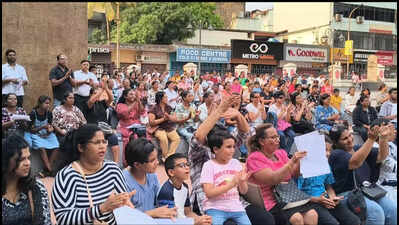
On March 30, 2025, a historic public meeting and protest was held at Lohia Maidan, Margao, with over 500 parents, students, and teachers in attendance, demanding immediate reversal of the decision. The protest highlighted the growing discontent among parents and the need for greater transparency and consultation in decision-making processes.

Second Writ Petition and Court’s Decision
On April 3, 2025, a fresh PIL Writ Petition was filed in the High Court of Bombay at Goa, challenging the notification of the Amendment to Rule 21 of the Goa School Education (Amendment) Rules 2025. However, the court dismissed the PIL within just one day, on April 4, 2025.
Parents were shocked to find that the court’s written order was filled with factual errors and based on false assumptions, leaving them questioning the justice system in the state.
 |
| Goa CM confirms school will re-open on announced date, amid parent protests, even before the matter was decided by the court! |
The Fight Continues
Despite the court’s decision, parents remain determined to continue their fight for a better education system in Goa. MP Viriato Fernandes has escalated the issue to the Union Education Minister, and Cecille Rodrigues has called for further mobilization, declaring that the fight will continue.
The controversy has highlighted the need for greater transparency and consultation in decision-making processes.
_____________________________________________
Do share your thought's with us in the comments below and if you're interested in contributing to Goa Education Matters or have ideas and feedback, you can reach us at goaeducationmatters@gmail.com
— Goa Education Matters
📧 goaeducationmatters@gmail.com
🌐 www.goaeducationmatters.com
To understand how these changes are affecting students on the ground, parents can share their feedback here: Parent Feedback & Experiences
Comments